

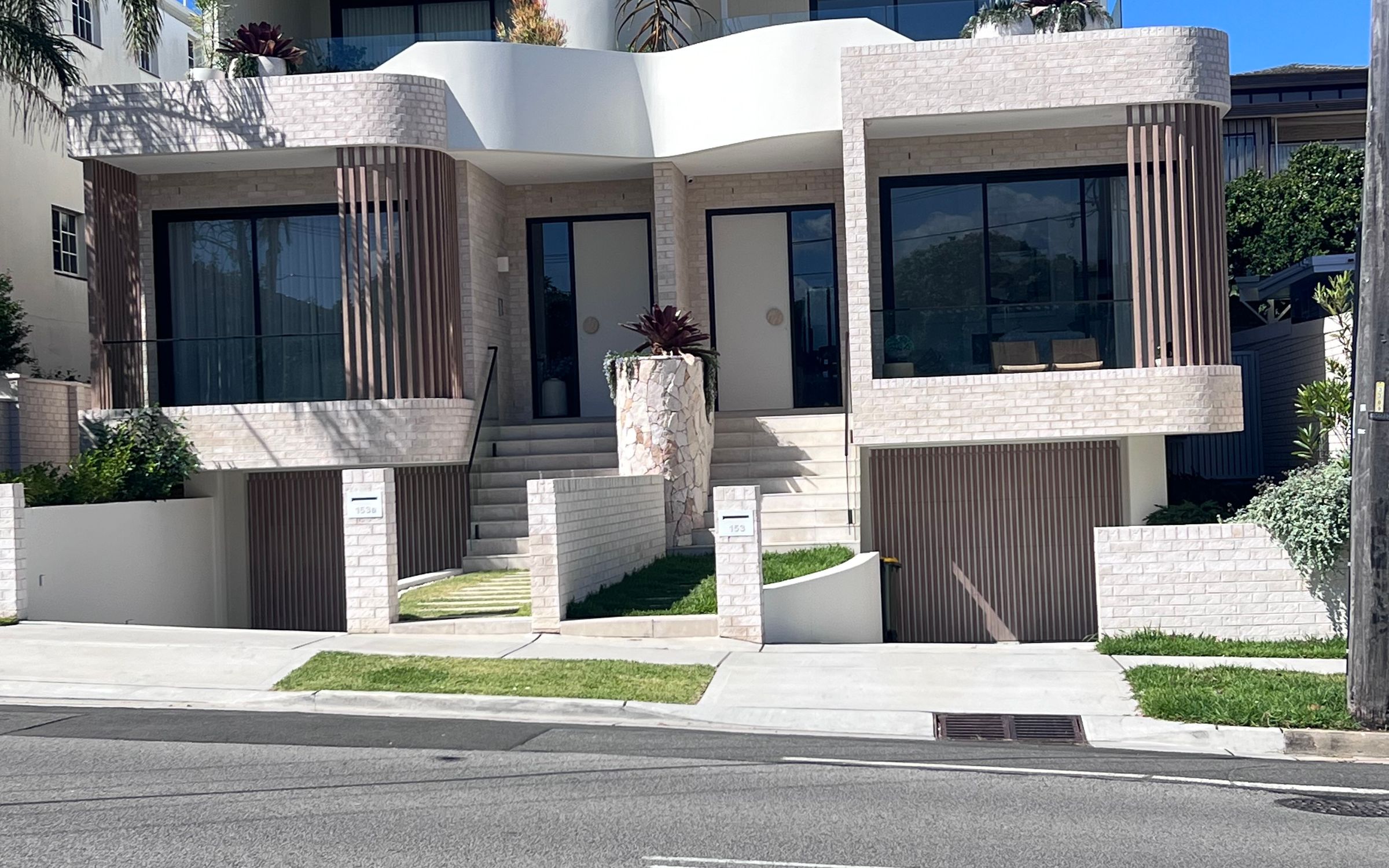
Part of our conveyancing guideThis article explains one aspect of buying property in Queensland. For each step from contract to settlement, see our main guide: Conveyancing Process in Queensland: 7 Steps to Buying a Property.
Quick answerA two-lot duplex does not automatically fall under Queensland’s Specified Two-lot Schemes Module. The scheme must have only two lots, no letting agent or layered arrangement, residential lots (subject to limited exceptions), and a community management statement (CMS) identifying that module. Where it applies, the two owners generally run the body corporate themselves through written lot owner agreements, and may engage a body corporate manager to help with administration. Insurance and maintenance costs are not necessarily split equally, and specific seller disclosure requirements apply.
Last reviewed: 26 November 2026
Key points at a glance
Buying one side of a duplex may also mean sharing responsibility for insurance, maintenance and common property with the owner next door.
What happens if there is no body corporate manager? Who chooses the building insurer, and is the premium split equally? Who maintains a shared front garden, driveway or roof? And what must the seller disclose before a buyer signs a contract?
The answers depend on the registered survey plan, the CMS and the regulation module that applies to the scheme.
1. Does the Two-lot Module Apply to Every Duplex?
No. Under section 111C of the Body Corporate and Community Management Act 1997 (Qld), a community titles scheme must meet the following requirements before the Body Corporate and Community Management (Specified Two-lot Schemes Module) Regulation 2011 can apply:
- Only two lotsThere are only 2 lots included in the scheme
- No layered arrangementThe scheme is not part of a layered arrangement of community titles schemes
- No letting agentThere is no letting agent for the scheme
- Residential lotsThe lots are used for residential purposes, including lots leased or available for lease
- CMS identifies the moduleThe registered CMS states that the Specified Two-lot Schemes Module applies
Limited exceptions preserve eligibility where the lots were originally intended to be residential, or were previously residential, provided the statutory conditions are met.
Some duplexes operate under a different regulation module, while others are separately titled properties that do not form part of a community titles scheme at all.
Check the documentsBuyers should check the CMS, title and registered survey plan rather than relying on the property being described as a duplex.
2. Is There a Body Corporate in a Two-Lot Scheme?
Yes, although it may not operate like a traditional body corporate.
A body corporate is legally established when a community titles scheme is created. However, the Specified Two-lot Schemes Module provides a simplified framework that allows the two lot owners to manage the scheme themselves.
In practice, there may be no body corporate manager, committee, formal meetings or regular administration fees. Instead, the two owners generally deal with each other directly about building insurance, maintenance, repairs and shared expenses.
How Are Decisions Made?
Under section 5 of the module, body corporate decisions are generally made through lot owner agreements. A lot owner agreement must:
- be in writing;
- be dated, or contain evidence of the date it was made;
- state details of the matter agreed; and
- be signed by both owners or, if made electronically, contain evidence of each owner’s approval.
An exchange of emails can satisfy these requirements if it complies with the Electronic Transactions (Queensland) Act 2001.
ExampleWhen the building insurance is due for renewal, one owner obtains quotes and emails them to the other owner. If both owners agree in writing on the insurer and policy, that email exchange may be a valid lot owner agreement.
The owners may engage a body corporate manager by lot owner agreement under section 11, but are not required to do so. The body corporate is also not required to keep a bank account.
Under section 70, the body corporate must appoint, by lot owner agreement, a person to keep its records. This may be one owner, both owners, an owner’s representative or a body corporate manager.
ImportantHaving no body corporate manager does not mean there is no body corporate, or that its legal obligations can be ignored.
If the owners cannot agree, the matter may need to go through Queensland’s body corporate dispute resolution process, such as conciliation or adjudication.
3. Who Arranges Building Insurance and Chooses the Insurer?
The insurance requirements depend on the registered survey plan.
- Building or volumetric format planUnder section 49, the body corporate must generally insure each building containing a lot for full replacement value, subject to limited exceptions. This applies even if the dwellings are freestanding.
- Standard format plan, buildings share a common wallUnder section 50, the body corporate must arrange a single policy with the same insurer, in its own name, covering the buildings for full replacement value. The policy may also give effect to a voluntary insurance scheme.
- Standard format plan, stand-alone buildingsThe body corporate is not required to insure the buildings. Each owner should arrange their own building cover, unless the owners set up a voluntary insurance scheme by lot owner agreement under section 55.
Who Chooses the Insurance Provider?
Where the body corporate must insure, the two owners should agree on the insurer and policy by lot owner agreement. One owner does not automatically have authority to choose an insurer or bind the other owner because they arranged the previous policy.
The owners should consider the cover, premium, excess and the insurer’s requirements before agreeing to renew or replace a policy.
The body corporate must also insure the common property and body corporate assets under section 48, and hold public risk insurance under section 56 of at least $10 million for a single event and $10 million for each period of insurance.
Where compulsory full replacement building insurance applies, section 51 requires an independent replacement valuation at least every five years. Each owner contributes to the valuation cost in proportion to their share of the reinstatement insurance premium.
4. Is the Building Insurance Premium Split 50/50?
Not necessarily. Different costs are shared on different bases:
| Cost | Usual basis for each owner’s share |
|---|---|
| Building insurance – building or volumetric format plan | Interest schedule lot entitlement (s 52(1)(a)) |
| Building insurance – standard format plan, common wall | Relative cost of reinstating the buildings on each lot (s 52(1)(b)) |
| Voluntary cover for stand-alone buildings | Share of total replacement value and lot-specific risks (s 55(4)) |
| Common property and body corporate assets insurance | Interest schedule lot entitlement (s 48(4)) |
| Five-yearly insurance valuation | Same proportion as the reinstatement premium (s 51(3)) |
| Other agreed body corporate expenses | Contribution schedule lot entitlement (s 24) |
Under section 52(2), the owners may adjust building insurance contributions by lot owner agreement in a way that fairly reflects higher-standard fixtures in one lot, common property improvements that benefit one lot, or differences in the risks from activities on each lot.
The contribution schedule and interest schedule should therefore be checked separately.
What About Voluntary Insurance for Stand-Alone Buildings?
Where a voluntary insurance scheme is set up under section 55, each owner’s premium contribution must fairly reflect:
- their building’s proportion of the total insured replacement value; and
- the risks from activities carried on, or proposed to be carried on, on their lot.
ExampleTwo stand-alone buildings are covered by a voluntary policy. One building represents 60% of their combined replacement value and the other 40%. Those proportions are the starting point, but differences in risk may produce a different final split.
Two-lot Scheme Interactive Guide
Use the interactive guide below to see whether the module is likely to apply, who arranges the building insurance, how a cost may be shared and who maintains a shared front yard. It gives general guidance only, based on the answers you select.
Interactive guide
Two-lot scheme guide
General guidance only. It does not review a particular CMS, survey plan or insurance policy.
Indicative result
The eligibility test is in section 111C of the Body Corporate and Community Management Act 1997.
Likely position
Indicative split
Likely starting point
5. Who Pays an Insurance Excess?
An insurance excess is not necessarily divided in the same proportions as the annual premium. Under section 54:
- An event affecting only one lotThe owner of that lot generally pays the excess, unless the body corporate decides by lot owner agreement that it is unreasonable in all the circumstances for that owner to bear it.
- An event affecting both lots, or a lot and common propertyThe body corporate generally pays the excess, unless a lot owner agreement decides that it is reasonable for a particular owner to pay it.
The policy wording and the circumstances of the claim must also be considered.
6. Who Maintains the Front Yard, Driveway and Shared Roof?
This is a common source of disagreement between duplex owners. The registered survey plan is the starting point: a front lawn that looks shared is not necessarily common property.
Front Yard or Garden
If the front yard is part of one owner’s lot, that owner will ordinarily maintain it. If the garden is common property, section 31 generally requires the body corporate to maintain it in good condition.
Where an exclusive use by-law gives one owner the use of common property, section 44 generally makes that owner responsible for its maintenance and operating costs, unless the by-law says otherwise. Structural exceptions apply to building format plans.
Shared Driveway
A common property driveway is generally maintained by the body corporate. Where the work is an agreed body corporate expense, including one treated as agreed under section 23 because it is required by law or an order, each owner ordinarily contributes in proportion to their contribution schedule lot entitlement under section 24.
Roof and Structural Elements
For building format plans, the body corporate must also maintain specified roofing membranes, foundations, load-bearing walls and other structural elements, even where they are not common property. The position may differ for standard format plans.
Fixtures and Utility Infrastructure
The body corporate is not responsible for everything on common property. Under section 31(3), it is not responsible for fixtures or fittings an occupier installed for their own benefit.
Under section 31(4), an owner is responsible for utility infrastructure serving only their lot, such as air-conditioning, hot water systems and solar panels, even where it is on common property.
Where a person’s actions cause or contribute to damage to a part of a lot the body corporate must maintain under section 31(2), the body corporate may recover from that person the share of its reasonable maintenance costs fairly attributable to those actions. This is not a general recovery power for every common property repair.
7. Can an Owner Install a Gate or Improve Common Property?
Neither owner should assume they can alter common property without the necessary authorisation.
Under section 35, improvements by the body corporate generally require a lot owner agreement, although an adjudicator may authorise improvements reasonably necessary for health, safety or security. Under section 36, an owner who wants to improve common property for the benefit of their lot ordinarily needs authorisation by lot owner agreement. An exclusive use by-law may also authorise particular improvements under section 45.
Installing a gate across a shared driveway, putting up fencing or changing shared landscaping may therefore require the other owner’s written agreement.
Who Insures Improvements to Common Property?
Where both lots are on a standard format plan with stand-alone buildings, no voluntary insurance scheme has been set up, and an owner improves common property, section 55(5) requires that owner to insure the improvement for full replacement value and give the other owner and the body corporate details of:
- The nature and value of the improvement
- The insurer, amount and type of cover
- The premium and any excess
- The date the cover expires
The policy must also cover damage and incidental costs as far as practicable, and provide for reinstatement to the improvement’s condition when new. These requirements do not apply to every duplex or every common property improvement.
8. What Seller Disclosure Must Be Given Before Signing?
Since 1 August 2025, the Property Law Act 2023 (Qld) has generally required sellers to give buyers prescribed disclosure documents before the buyer signs a contract. See our page on seller disclosure in Queensland. For an existing lot in a specified two-lot scheme, the documents ordinarily include:
- Seller Disclosure Statement (Form 2)
- BCCM Form 34 body corporate certificate
- The registered community management statement
- The registered survey plan
Form 34 sets out information about the scheme, including lot entitlements, insurance, contributions, amounts owing and who keeps the records. Buyers should also ask for the insurance policy, certificate of currency, recent premium notices, replacement valuation, lot owner agreements and maintenance records. These are not necessarily required to accompany the disclosure statement.
What if There Is No Body Corporate Certificate?
Under section 6(1)(a) of the Property Law Regulation 2024 (Qld), a seller may give a prescribed explanatory statement instead of the body corporate certificate where the body corporate has advised the seller in writing that it does not have records that could be used to prepare the certificate, for example because the records are missing, destroyed or in disarray.
The explanatory statement must state that the certificate is not attached and give the statutory reason the seller could not obtain it.
No manager is not an exemptionHaving no body corporate manager does not, by itself, excuse the seller from giving the certificate. The separate “no committee or manager” exemption in section 6(1)(b) applies only to schemes governed by other regulation modules, not the Specified Two-lot Schemes Module.
Can a Buyer Terminate for Incorrect Seller Disclosure?
Under section 104 of the Property Law Act 2023, a buyer may be able to terminate where the seller fails to give the disclosure statement or a prescribed certificate before the buyer signs.
A buyer may also be able to terminate where the disclosure is inaccurate or incomplete about a material matter affecting the lot, the buyer was unaware of the correct position when signing, and would not have entered the contract had they known. Written notice must be given before settlement, and statutory exceptions apply. Not every error or omission gives a right to terminate.
9. Buyer Checklist for a Two-Lot Scheme
Before signing a contract to buy into a two-lot scheme, tick off each item as you receive and review it.
Your two-lot scheme buyer checklist0 of 10 checked
All ten checked. You have the key documents and answers before signing.
In a two-owner scheme, a disagreement over insurance, maintenance or major repairs can have a significant practical impact. These issues should be investigated before signing, particularly where the seller or agent has said there is “no body corporate”. Our page on buying and selling units in a body corporate explains more.
Frequently Asked Questions
Does a two-lot duplex have a body corporate if there is no manager?
Yes, if it is a community titles scheme. A body corporate exists from the time the scheme is created. The two owners can manage it themselves through written lot owner agreements without engaging a body corporate manager, but it must still meet its insurance, maintenance and record-keeping obligations.
Do we have to split building insurance 50/50 because there are two owners?
No. For building or volumetric format plans, the premium generally follows interest schedule lot entitlements. For standard format plans, it generally follows the relative cost of reinstating the buildings on each lot. The owners can adjust the shares by lot owner agreement in limited circumstances.
Can we each insure our own half of a duplex?
Not if the lots are on a standard format plan and the buildings share a common wall. In that case the body corporate must arrange a single policy with the same insurer, in its own name, covering both buildings for full replacement value. Separate policies for each half will not satisfy this requirement.
Can one owner choose the insurer without the other owner agreeing?
Generally no. Where the body corporate must insure, the insurer and policy should be agreed by written lot owner agreement. The owners must not allow a disagreement to leave the scheme uninsured.
If the front garden is common property, who maintains it?
Generally the body corporate, with the cost shared under the contribution schedule. If an exclusive use by-law gives one owner the garden, that owner is usually responsible for its maintenance and operating costs, unless the by-law says otherwise.
What if the seller does not provide a Form 34 body corporate certificate?
A Form 34 is ordinarily required. A seller can give an explanatory statement instead only where the body corporate has advised in writing that it does not have records that could be used to prepare the certificate. Having no body corporate manager is not, by itself, an exemption.
Who pays for the five-yearly insurance valuation?
Where full replacement building insurance is compulsory, each owner contributes to the valuation cost in proportion to their share of the reinstatement insurance premium.
Key takeawayA duplex in a two-lot scheme still has a body corporate. Before signing, confirm the regulation module, the plan type, who insures the buildings, how costs are shared and who maintains the shared areas.
This article provides general information only and does not constitute legal advice. The applicable legislation, regulation module, registered survey plan, CMS, by-laws and individual circumstances should be reviewed before acting.
How Vojdani Lawyers Can Assist
Vojdani Lawyers advises Queensland buyers and owners on residential property transactions, seller disclosure and community titles arrangements.
We can review the CMS, survey plan and Form 34, together with the insurance and maintenance obligations that apply to the property, before you commit to buying.
Contact Vojdani Lawyers for advice before buying a duplex or other property in a Queensland two-lot scheme. Contact our office for costs related to your matter. We endeavour to respond to enquiries as soon as possible.
Insights
Related articles
Practical guides on property and conveyancing from our Gold Coast team.
 Article · 25 Sept 2026Conveyancing Process in Queensland: 7 Steps to Buying a PropertyUnderstand the conveyancing process in Queensland, from contract review and cooling-off to searches, settlement…Read article
 Article · 2 Sept 2026Who Pays Rates, Water and Body Corporate Levies at Settlement?Who pays council rates, water and body corporate levies at settlement in Queensland? How settlement adjustments work…Read article
 Article · 14 Aug 20265 Things to Check Before Signing a Residential Property Contract in QueenslandSigning a property contract in Queensland? Check the terms, finance and building conditions, inclusions, seller disclosure…Read article