

Part of our conveyancing guideThis article explains one aspect of buying and selling property in Queensland. For each stage from contract to keys, see our main guide: Conveyancing Process in Queensland: 7 Steps to Buying a Property. For an overview of the disclosure regime, see Seller Disclosure in Queensland.
Quick answerYes. A Queensland buyer may be entitled to terminate a property contract if the seller did not give the required disclosure documents before the buyer signed, or gave documents that were inaccurate or incomplete about a material matter. Under section 104 of the Property Law Act 2023 (Qld), the two grounds work differently: a missing document can give a right to terminate without proving materiality, while an inaccurate document must meet additional tests. Any termination notice must be given before settlement.
Last reviewed: 15 November 2026
Key points at a glance
1. What Must the Seller Disclose?
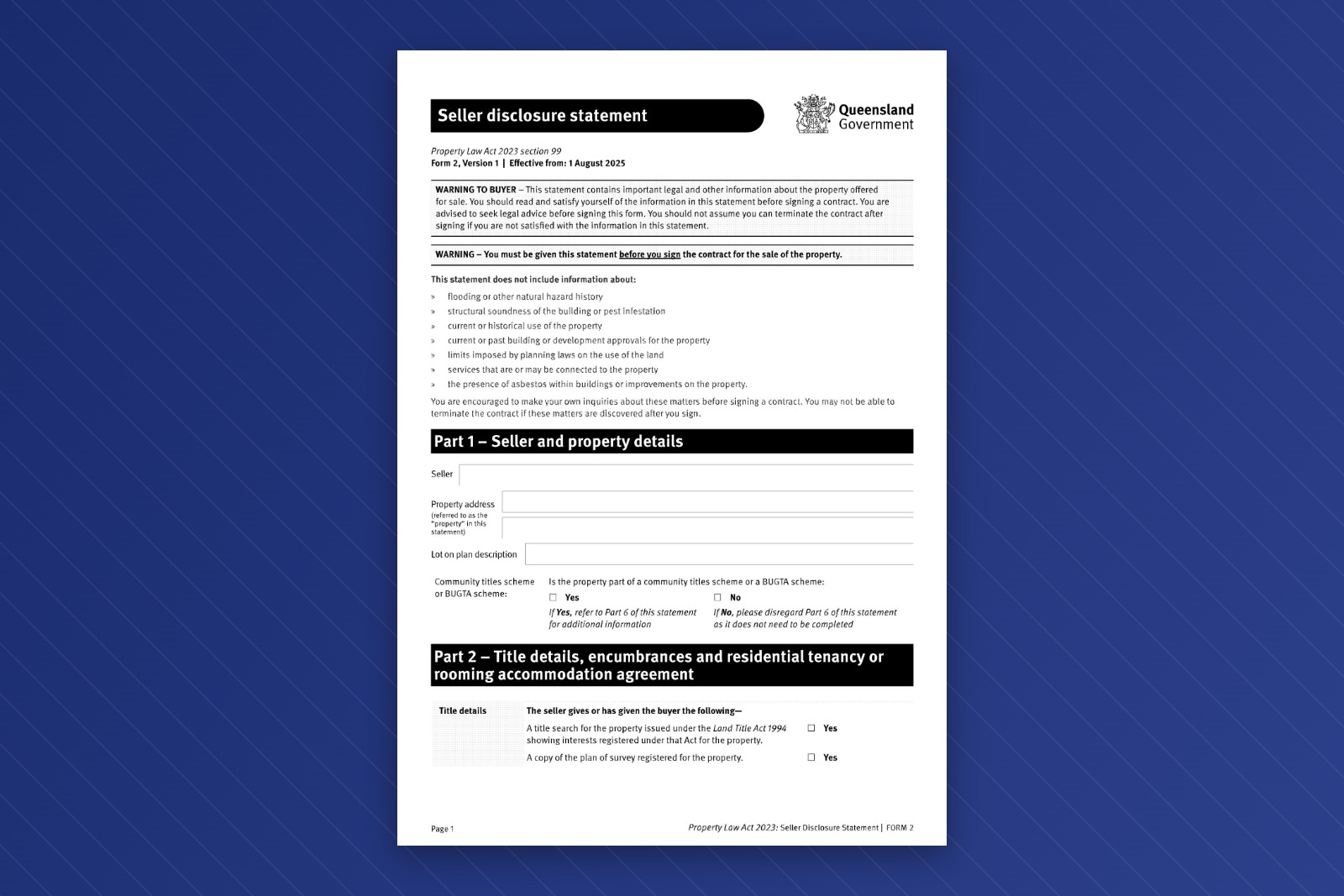
Since 1 August 2025, under section 99 of the Property Law Act 2023 (Qld), a seller of a lot in Queensland must generally give the buyer a signed disclosure statement in the approved form (Form 2) and any prescribed certificates before the buyer signs the contract. The statement must be complete and true when it is given. The regime covers residential property, commercial property and vacant land, subject to exceptions.
Depending on the property, disclosure includes title details, registered and unregistered encumbrances, zoning and certain environmental and government notices. Supporting documents may include a current title search, survey plan and, for community titles lots, a body corporate certificate.
For sellersBefore listing, review the title, any registered and unregistered encumbrances, notices and body corporate records, and make sure Form 2 and the prescribed certificates are complete and accurate. If there is a dispute, the seller bears the onus of proving that disclosure was given.
A disclosure statement is not a substitute for the buyer’s own searches and enquiries.
2. Can a Buyer Terminate if Form 2 Is Missing?
Yes, where the disclosure obligation applies. Under section 104(1)(a), the buyer may terminate if the seller did not give the disclosure statement, or an applicable prescribed certificate, before the buyer signed. The buyer does not need to prove that the missing document was material or that its absence caused loss.
For example, if the seller was required to give Form 2 but the buyer signed without receiving it, the buyer may have a right to terminate. Providing the document after the buyer signs does not cure the failure.
3. What if the Statement Is Wrong or Incomplete?
Where the documents were given but contain an error or omission, not every mistake allows termination. Under section 104(1)(b), all three of the following must be met:
- Material matterThe statement or certificate was inaccurate or incomplete about a material matter affecting the lot when it was given
- Buyer unawareThe buyer was not aware of the correct position when signing
- Would not have signedThe buyer would not have signed the contract had they known the correct position
For example, a buyer may discover an undisclosed unregistered easement that substantially restricts their intended use of the land. If it was required to be disclosed, was material and the buyer would not have signed knowing the true position, termination may be available. Disagreements about materiality or what the buyer knew can lead to a dispute, so advice should be obtained before acting.
4. What Counts as a Material Matter?
Materiality depends on the nature of the error and its effect on the property. An undisclosed lease affecting vacant possession, or a significant error about environmental restrictions, may be material depending on the circumstances.
However, section 10 of the Property Law Regulation 2024 (Qld) provides that the prescribed information about rates and water services is not a material matter. An inaccuracy in those items does not, on its own, give a right to terminate under section 104(1)(b).
Do your own checksForm 2 does not cover everything a buyer may care about, such as flooding history or the structural condition of a building. Buyers should still carry out searches and obtain building and pest inspections where relevant.
5. When and How Must the Buyer Terminate?
Under section 104(2) and (3), the buyer terminates by giving the seller a termination notice, which may be given at any time before settlement. This right is separate from the five business day cooling-off period.
Under section 104(4), the right does not apply where the same failure also breaches another Act and that Act provides a consequence for the seller or a remedy for the buyer. However, under section 104(5), a failure is not treated as having such a consequence merely because it is an offence under the other Act.
Get advice before giving noticeDiscovering an error does not automatically end the contract. A termination notice given without a valid ground could itself put the buyer in breach.
6. What Happens to the Deposit?
Under section 105, after a valid termination under section 104, the seller must repay the amounts paid towards the purchase, together with any interest earned on them, within 14 days after termination. This generally includes the deposit, and unlike cooling-off termination, no 0.25% penalty applies.
The seller does not have to repay collateral amounts for which the buyer received separate value, such as occupation rent or contributions for rates and maintenance.
7. Are There Exceptions?
Yes. Under section 100, the disclosure requirement does not apply in a number of situations, including:
- Related partiesThe buyer and seller are related and the buyer gives a waiver notice before signing
- Sales over $10 millionThe price exceeds $10 million including GST and the buyer gives a waiver notice before signing
- Certain buyersThe buyer is the State, the Commonwealth, a local government, a statutory body, a listed corporation or its subsidiary
- Other transactionsFor example, transfers between co-owners, boundary adjustments, court orders, deceased estates and certain options
Sales of proposed lots, including many off-the-plan purchases, are dealt with under separate disclosure requirements. Buyers and sellers should confirm which regime applies before relying on section 104. Read more on our Seller Disclosure in Queensland page.
Frequently Asked Questions
Does a buyer need to prove financial loss to terminate for a missing Form 2?
No. Under section 104(1)(a), the termination right arises from the failure to provide the required document before the buyer signed. The buyer does not need to prove that the missing document was material or that its absence caused financial loss.
Can a buyer terminate for any mistake in the disclosure statement?
No. For an inaccurate or incomplete statement, the error must relate to a material matter, the buyer must not have known the correct position when signing, and the buyer must not have signed had they known. Errors in the rates and water information are not material for this purpose.
How long does a buyer have to terminate for a disclosure failure?
The termination notice may be given at any time before settlement. After settlement, the statutory right to terminate under section 104 is no longer available.
Does the seller keep any of the deposit?
No penalty applies. After a valid termination under section 104, the seller must repay the amounts paid towards the purchase, with any interest, within 14 days.
Key takeawaySellers should get disclosure right before the property is marketed. Buyers who discover a missing or inaccurate statement should get advice before settlement, as that is when the right to terminate ends.
This article provides general information only and does not constitute legal advice. Whether a right to terminate exists depends on the documents given, the property and the facts of the particular transaction.
How Vojdani Lawyers Can Assist
Vojdani Lawyers assists Queensland buyers and sellers with preparing and reviewing seller disclosure statements and assessing termination rights before settlement. If a disclosure statement is missing or appears inaccurate, seek advice before giving any notice.
Contact Vojdani Lawyers to discuss your disclosure documents. Contact our office for costs related to your matter. We endeavour to respond to enquiries as soon as possible.
Insights
Related articles
Practical guides on property and conveyancing from our Gold Coast team.
 Article · 24 Mar 2026How Does the Cooling-Off Period Work in Queensland?How the Queensland cooling-off period works: when the 5 business days start, the 0.25% termination penalty,…Read article
 Article · 27 Mar 2026What Happens if You Miss the Finance Date in Queensland?Missed the Finance Date in a Queensland property contract? How clause 4.1 of the REIQ contract works, who can…Read article
 Article · 9 Mar 2026Building and Pest Inspection Conditions: Can a Buyer Terminate a Queensland Property Contract?When can a Queensland buyer terminate under the building and pest condition? Clause 4.2 of the REIQ contract,…Read article